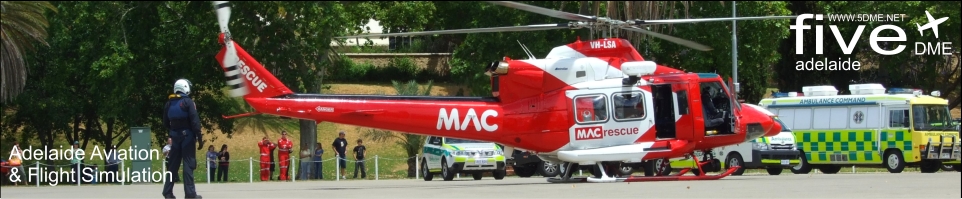
MAC Rescue Helicopter Service
1) History of the State Rescue Helicopter Service
- In the late 1970's a number of organisations involved in providing emergency services began talks with Government about providing helicopter capacity in South Australia. Guy Lloyd, of Lloyd Helicopters saw an opportunity to be involved and was able to provide leadership and advice to the agencies on how the service could be developed.
- In the summer of 1979/80 a trial was undertaken by Surf Lifesaving, using a Bell 206 Jetranger helicopter, servicing the local South Australian beaches. There was a significant rescue where a life was saved which demonstrated that the helicopter service had a major and indeed a broader role to play in state rescues. After the Liberal Party won the election, the new premier David Tonkin indicated the intention to widen the concept to a State Service.
- The State Government in May 1980 approved the establishment of a full time State Rescue Helicopter Service (SRHS) to be operated by Lloyd Helicopters. A Bell 206L Long Ranger VH-BJX 'Rescue 1' commenced operations. By this time government organisations using helicopters were: Police, CFS, Health (Retrieval Teams), Ambulance services and independently run Surf Lifesaving.
- Special facilities were opened at Adelaide Airport in 1980 to house the rescue helicopter operations.
- Additional helicopters were progressively added and in 1990 the first Bell 412 VH-NSC came into service.
- Operators of the service have been Lloyd Helicopters, CHC Helicopters, and from 11 December 2005, Australian Helicopters Pty Ltd. The new operator gained the rescue contract for a term of seven years. They now operate from a specially built complex near Harbour Town at Adelaide Airport.
- Previous sponsors of the Rescue Helicopter Service have included Bank of New South Wales, Westpac Bank, S.G.I.C., and Adelaide Bank. The Motor Accident Commission took over sponsorship from 1 July 2009.
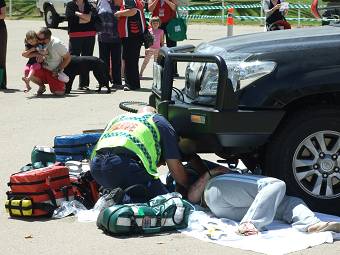 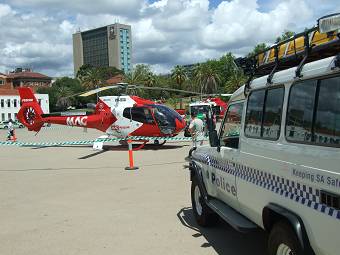
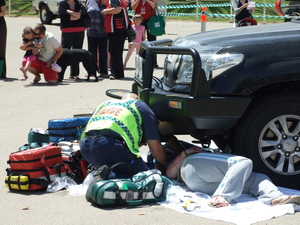
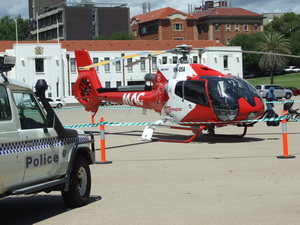
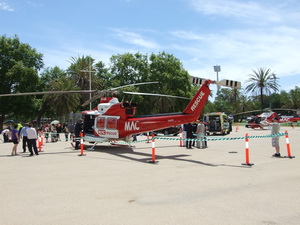
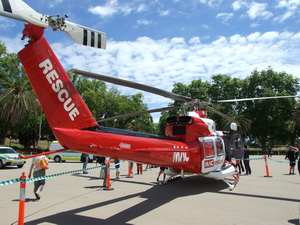
On display at the Torrens Parade Grounds, Public Sector Week November 2009.
2) Background
Today, the South Australian State Rescue Helicopter Service ("MAC Rescue Helicopter Service") is a multi-helicopter service that is principally used by 4 emergency services agencies to support the provision of police, bushfire services, and emergency medical retrieval services to the South Australian community.
Australian Helicopters Pty Ltd is the service provider engaged to supply the helicopters and aircrew and carry out the day-to-day operations of the MAC Rescue Helicopter Service ("MAC RHS").
The service continues to be well recognised for operating as an effective shared user arrangement which is unique to South Australia.
The cooperation of the user agencies saves dollars by eliminating the need for separate helicopter service contracts in each agency. More importantly, it provides a flexible and efficient service that saves lives.
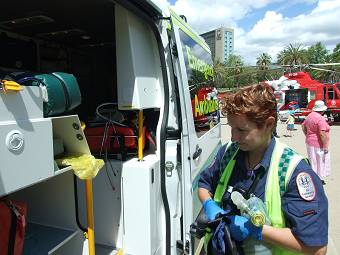 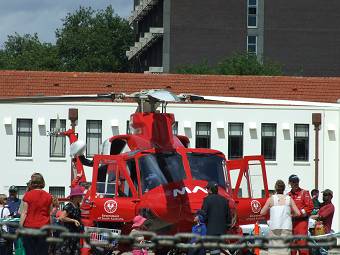
On display at the Torrens Parade Grounds, Public Sector Week November 2009.
3) Roles performed
The helicopters in operation perform a variety of tasks in the support of the user agencies. The following table indicates the core tasks that are performed for each agency:
|
USER AGENCY
|
TASK
|
|
SA Health (DH)
|
- Emergency aero medical retrieval
- Non emergency aero medical retrieval / patient transfer
|
|
SA Ambulance Service (SAAS)
|
- Patient retrieval / paramedic insertion in difficult access /
egress environments
|
|
SA Police (SAPOL)
|
- Aerial command platform
- Search and rescue over land and water
- Intelligence gathering
- Crime prevention and detection
- Observation
- Special tasks
|
|
SA Country Fire Service (CFS)
|
- Aerial command platform
- Fire mapping and observation
- Fire bombing
- Air attack supervision
|
|
All users
|
- Transport of personnel and equipment
- Training
|
There are also a small number of external users which access the MAC RHS from time to time. The main one is the Australian Maritime Safety Authority (AMSA), which is the Commonwealth government body responsible for the search and rescue response to national civil aviation and maritime distress incidents.
4) Role of Justice Business Services
Justice Business Services (JBS) within the Attorney-General's Department manages the contract and funding arrangements for the MAC RHS, as well as the service partnering agreement between the key user agencies.
5) Aircraft
Australian Helicopters service the MAC RHS requirements with the following three aircraft:
- The "Agusta Bell 412", the largest helicopter, is used mostly by SA Health for primary aero-medical retrievals and by SAPOL / SAAS for winch rescue missions.
- The "BK 117" is also regularly used by Health for inter hospital retrievals. It is also the back up winch aircraft and is also used by SAPOL and CFS.
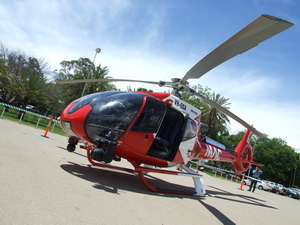
- The "EC 130" is regularly used by SAPOL for surveillance and patrol missions, pursuits, and search and rescue over land and water. The CFS also often uses this helicopter for intelligence missions to collect and disseminate information during a bushfire or for command and control of water bombing operations. It also has an aero-medical capability.
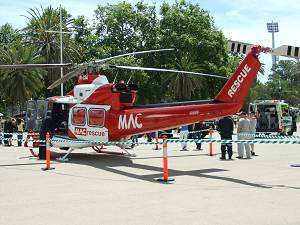 5.1) Agusta Bell 412 (AB412) 5.1) Agusta Bell 412 (AB412)
Also known as Rescue Five One (Rescue 51 or RS51), medium twin, VH-LSA.
Performs the following key taskings:
- aero medical retrieval (up to 4 patients)
- neonatal retrieval (with cot and lifter)
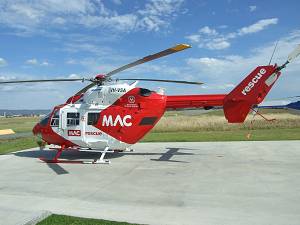 5.2) BK117 5.2) BK117
Also known as Rescue Five Two (Rescue 52 or RS52), light twin, VH-VSA.
Performs the following key taskings:
- aero medical retrieval (up to 2 patients)
- neonatal retrieval (takes cot)
- high speed chase in poor weather - due to infra-red capability
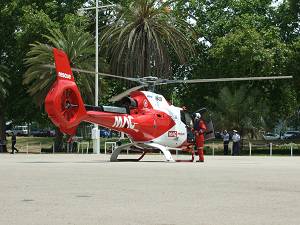 5.3) EC130 (single) 5.3) EC130 (single)
Also known as Rescue Five Three (Rescue 53 or RS53), single, VH-OSA.
Performs the following key taskings:
- Police surveillance and patrols with the capacity to carry a STAR Group team
- search and rescue over land and water
- aero medical back-up (1 patient)
- neonatal retrieval (takes cot).
See the 5DME Photo Gallery for more images.
Photos by David H.
Produced by 5DME.

|
Hot Topic Archive Article....
|
MAC Rescue Helicopter Service - Public
Sector Week Event 2009
WOW! What a great day. Well worth the look. Lots of photos and video to come
from 5DME.
MOTOR ACCIDENT COMMISSION
RESCUE HELICOPTER SERVICE
On 26 November 2009, as part of Public Service Week, the rescue service was
placed on display at the Torrens Parade Ground, King William Road, North
Adelaide.
Two rescue helicopters 'Rescue 51' a Bell 412 VH-LSA and 'Rescue 53' an EC130
VH-OSA ferried in from Adelaide Airport to participate in the proceedings.
.JPG)
Photos by
David H.
|
|
M.A.C. RESCUE HELICOPTER SERVICE
See our Gallery
page for
video and more!
|
Events like this only go to show how important aviation has become in our
community. In emergency cases we are almost dependent on such services.
|
Back to STORIES index page
|